
Recycled HDPE & PVC Granules for Pipe Manufacturing: A Complete Guide for Gujarat Manufacturers
Plastic pipes run under almost every street, field and factory in Gujarat. HDPE and PVC pipes carry drinking water across Ahmedabad and Rajkot, drip irrigation networks reach farms across Saurashtra and North Gujarat, and industrial and drainage pipes serve the chemical belts of Ankleshwar and Vapi. With so much pipe being produced every year, raw material cost is one of the biggest levers a manufacturer has.
That is why more extruders are exploring HDPE & PVC Granules made from recycled material for pipe manufacturing. Pipes carry pressure, last for years underground and, in many cases, carry drinking water, so this is one of the more demanding uses for recycled granules. Used carefully, and only in applications where it is appropriate, HDPE & PVC granules can still deliver real savings without compromising performance.
This guide explains where recycled HDPE & PVC granules fit in pipe manufacturing, what standards apply, and how Gujarat manufacturers can use them responsibly.
Why Pipe Manufacturers in Gujarat Are Looking at HDPE & PVC Granules
Gujarat has one of India’s largest concentrations of plastic pipe manufacturers, serving agriculture, construction, water supply and industry. Competition is intense, and virgin resin prices move with crude oil and global supply, which makes raw material cost management critical.
Three factors are driving interest in recycled HDPE & PVC granules.
Cost pressure. Recycled granules are typically priced below virgin resin, which helps manufacturers stay competitive on large government and agricultural tenders where price matters greatly.
Scrap volume. Pipe manufacturing itself generates trim scrap, off-spec pipe and rejected lengths. Reprocessing this in-house or through a trusted recycler avoids waste and recovers value.
Sustainability expectations. Government schemes and larger buyers increasingly favour suppliers who demonstrate responsible material use, and EPR rules are pushing the whole plastics industry toward higher recycled content where feasible.
Where HDPE & PVC Granules Fit in Pipe Manufacturing
Not every pipe can use recycled material, and this is the single most important point in this guide. Pipes fall into a few broad categories, and each has different tolerance for recycled content.
Pressure pipes for drinking water carry strict quality and safety requirements. Recycled content in these pipes is tightly restricted or requires certified, traceable material, because failure risks public health and safety.
Non-pressure and drainage pipes, such as sewage, drainage and casing pipes, generally have more flexibility for recycled content, since the performance and safety requirements are lower.
Agricultural and irrigation pipes, including certain drip and sprinkler system components, often use a blend of virgin and recycled material, subject to relevant standards.
Conduit and cable protection pipes used in electrical and telecom work are a common and practical use for recycled HDPE & PVC granules, since they do not carry water pressure.
Before using recycled content in any pipe product, check the applicable Bureau of Indian Standards specification for that pipe type and confirm what it permits.
Recycled HDPE Granules for Pipe Manufacturing
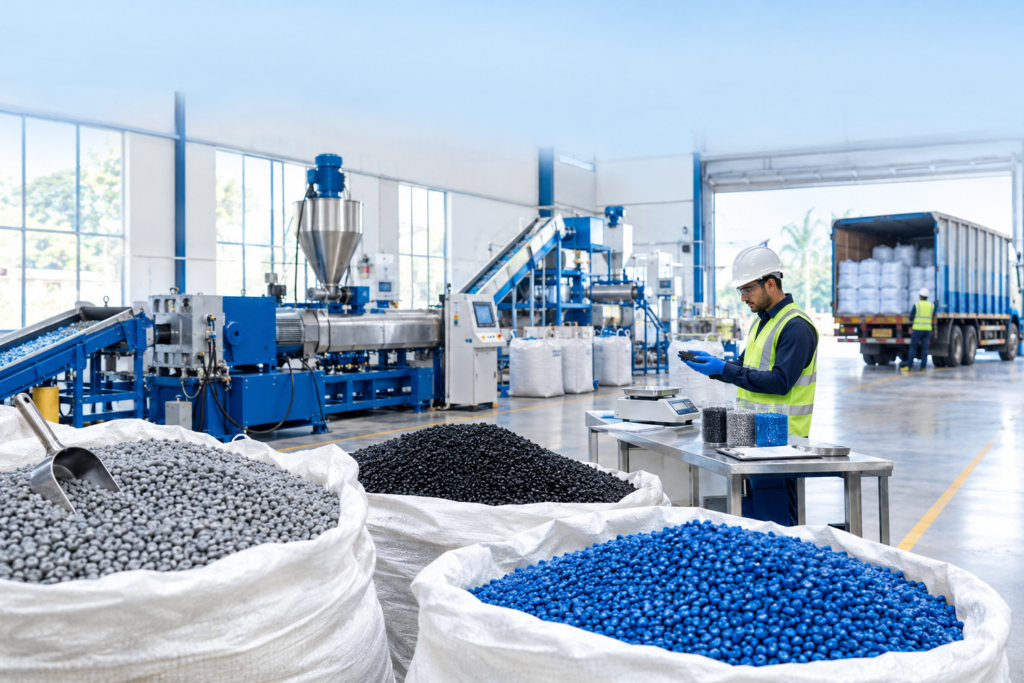
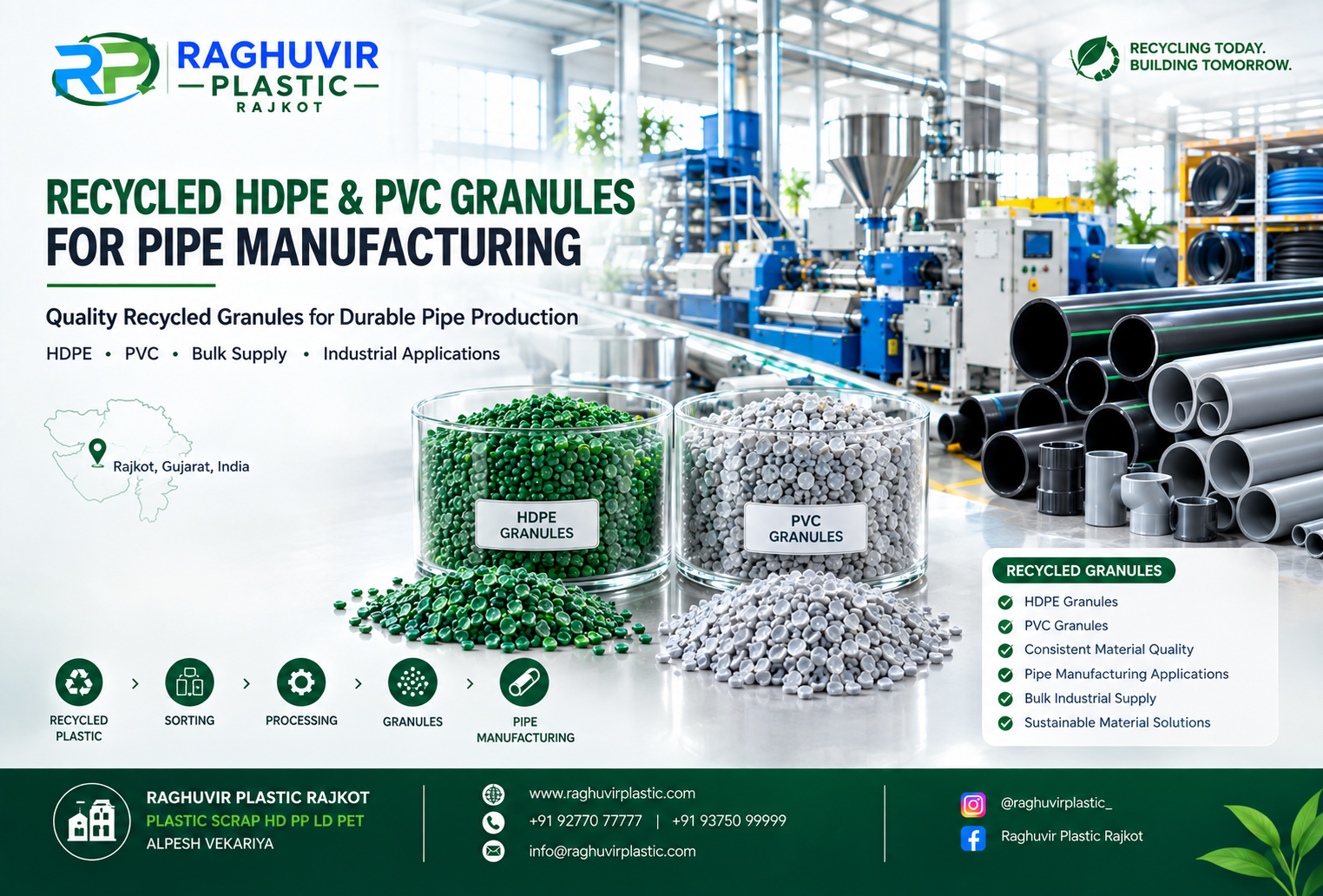
HDPE is the most common polymer for water, gas and general-purpose pipe, valued for its toughness and flexibility. Recycled HDPE from pipe trim, drums and crates can be reprocessed into granules for non-pressure and conduit applications. Pipe grade material needs the right density and environmental stress crack resistance (ESCR), since pipes must resist long-term stress without cracking.
If your production line uses HDPE, take a look at our HDPE & PVC Granules to see the grades we currently supply for extrusion applications.
Recycled PVC Granules for Pipe Manufacturing
PVC is widely used for water supply, drainage, casing and conduit pipes. Recycled PVC, often from pipe manufacturing scrap and construction offcuts, can be reused in non-pressure and conduit pipes. PVC needs careful control of stabilisers and additives during reprocessing, since these affect long-term performance and durability.
Recycled PP in Pipe-Related Applications
Polypropylene is used in some drainage, chamber and fitting applications. Recycled PP granules can work well here, similar to their use in other molded and extruded products, though it is used less widely in pipe manufacturing than HDPE & PVC granules.
Key Properties That Matter for Pipe-Grade Granules
Pipes are a long-term, structural application, so the bar for recycled material is higher than for many other products.
Environmental stress crack resistance (ESCR). Pipes are under continuous stress for years, so poor ESCR can lead to long-term failure. This is one of the most important properties to verify in HDPE & PVC granules before use.
Density and melt flow. These affect how the pipe extrudes and its final wall strength. Pipe grade granules typically have different melt flow requirements than injection or blow molding grades.
Consistency. Pipe walls must be uniform along the entire length, so batch-to-batch consistency in the granules is critical to avoid weak spots.
Cleanliness. Contaminants can create weak points that lead to cracks or leaks under pressure or soil load.
Compliance with BIS standards. Relevant standards, such as those covering HDPE and PVC pipes for water supply, sewerage and agriculture, specify what raw material, including recycled content, is permitted. You can review current specifications on the Bureau of Indian Standards website.
Benefits of Using HDPE & PVC Granules in Pipe Manufacturing
- Lower raw material cost, which helps on high-volume, price-sensitive tenders.
- Reduced waste, since pipe trim, rejects and offcuts can be reprocessed instead of discarded.
- Support for circular manufacturing, where a plant’s own scrap becomes part of its own supply chain.
- Alignment with sustainability expectations from larger buyers, government projects and EPR requirements.
- Flexibility, since recycled and virgin material can be blended, or recycled granules can be used in the inner or outer layer of a multilayer pipe.
Common Challenges When Using HDPE & PVC Granules
Reduced long-term strength. Repeated heat history can affect ESCR and long-term hydrostatic strength. Solve this by blending with virgin resin, limiting recycled content to non-pressure applications, and testing long-term performance before scaling up.
Inconsistent wall thickness. Variation in melt flow between batches causes extrusion problems. Ask for consistent, tested granules and adjust die and haul-off settings carefully.
Contamination and weak spots. Even small contaminants can create failure points in a pressure-bearing pipe. Use melt filtration and buy from suppliers with proper washing and screening processes.
Colour limitations. Recycled HDPE & PVC granules are rarely bright white or fully uniform in colour. This is generally acceptable for non-visible or underground pipes, but matters for visible conduit work.
Standards compliance. Using recycled content in a pipe type where it is not permitted, or without following the specified limits, risks rejection and liability. Always check the relevant BIS standard before finalising your material plan.
Practical Tips for Working with HDPE & PVC Granules
- Separate pipe applications clearly. Decide upfront which products can use recycled content and which must remain virgin, based on pressure rating and end use.
- Reprocess your own scrap first. In-house trim and rejects are usually the most consistent and traceable source of recycled material.
- Start with a conservative blend. Begin with a modest share of recycled content in non-critical applications, then adjust based on test results.
- Test long-term performance. For pressure-related uses, hydrostatic and stress crack testing over time is essential, not optional.
- Keep records by batch. Track which recycled lots went into which production runs, particularly for regulated pipe types.
- Work with certified recyclers. Choose suppliers who can demonstrate proper processing and, where relevant, provide documentation for compliance purposes.
How to Choose a Supplier of HDPE & PVC Granules in Gujarat
- Application-specific grades. The supplier should understand the difference between pipe grade and other grades, and offer material suited to extrusion.
- Test data. Ask for melt flow, density and, where possible, ESCR or stress crack test results.
- Batch consistency. Pipe production runs continuously, so consistent material matters more here than almost anywhere else.
- Proper processing. Washing, filtration and quality checks should be part of the recycler’s process, not just shredding.
- Documentation. For any regulated pipe type, ask what documentation the supplier can provide to support compliance.
- Local delivery. Confirm the supplier can reliably serve your plant, whether you are in Rajkot, Ahmedabad, Morbi, Mehsana or another Gujarat industrial cluster.
Regulation and Standards to Keep in Mind
Plastic pipes in India are governed by Bureau of Indian Standards specifications covering materials, dimensions and testing for different pipe types, including those used for drinking water, sewerage, agriculture and general use. These standards specify what raw material is acceptable, and recycled content is generally more restricted for pressure and potable water applications than for non-pressure uses.
Separately, India’s Plastic Waste Management Rules and associated EPR guidelines continue to push the wider plastics industry toward higher, responsibly sourced recycled content. You can check current notifications on the Central Pollution Control Board website. Manufacturers should track BIS updates and these notifications together, since both affect what is permitted and expected.
Work with Raghuvir Plastic for HDPE & PVC Granules
At Raghuvir Plastic, we understand that pipe manufacturers need raw material that is consistent, well-documented and suited to extrusion. Whether you are looking to reprocess your own scrap, source HDPE & PVC granules for non-pressure applications, or explore a virgin-recycled blend, our team can help you evaluate options and arrange trial quantities. Contact Raghuvir Plastic with your product and application details, and we will help you find a material that fits your requirements.
Frequently Asked Questions
Can HDPE & PVC granules be used for water supply pipes?
Recycled content in drinking water pressure pipes is tightly restricted or requires certified, traceable material under applicable standards. It is more commonly used in non-pressure, drainage and conduit pipes.
Which is better for pipe manufacturing, recycled HDPE or PVC granules?
Recycled HDPE is widely used for non-pressure and conduit pipes, while recycled PVC suits drainage and casing applications. The right choice depends on the pipe type and application.
Is recycled plastic as strong as virgin plastic for pipes?
Not always. HDPE & PVC granules made from recycled material can have somewhat reduced long-term strength and stress crack resistance, which is why they are generally used in non-pressure applications or blended with virgin resin.
How much recycled content can I use in a pipe?
This depends on the pipe type and the relevant BIS standard. Non-pressure and conduit pipes generally allow more flexibility than pressure and drinking water pipes.
Can I reuse my own pipe manufacturing scrap as granules?
Yes, in-house trim, offcuts and rejects can often be reprocessed into granules and reused, typically in a blend with virgin resin, subject to the standard that applies to your product.
Where can I buy HDPE & PVC granules for pipe manufacturing in Gujarat?
Look for recyclers who understand pipe-grade requirements and can provide test data and sample lots. You can contact Raghuvir Plastic with your requirement for guidance.
Conclusion
HDPE & PVC granules made from recycled material can lower costs and reduce waste in pipe manufacturing, but they demand more caution than most other applications because pipes carry pressure, last for years and sometimes carry drinking water. Match recycled content to the right pipe type, check the applicable BIS standard, test thoroughly, and work with a supplier who understands pipe-grade requirements.
Ready to explore HDPE & PVC granules for your pipe production? Contact Raghuvir Plastic today to discuss your requirements and request a sample.