
Recycled Polymer Supplier Gujarat: Grades, Forms, Quality and Buying Guide
From the water tanks on rooftops in Rajkot to the pipes under fields in Saurashtra, from the crates in Surat’s markets to the sacks leaving Kutch’s ports, polymers are everywhere in Gujarat. More and more of them are now made from recycled material. Manufacturers want lower and steadier costs, and customers increasingly ask for recycled content. If you are looking for a dependable recycled polymer supplier Gujarat has to offer, this guide will help you understand what is available, how to judge quality and how to buy with confidence.
Choosing the right recycled polymer supplier Gujarat manufacturers can rely on protects your machines, stabilises your costs and keeps your product quality steady. Below, we explain what recycled polymer is, which grades and forms exist, how it compares with virgin resin, how to test it, what affects price and what to watch for on compliance.
What Is Recycled Polymer?
A polymer is the material that plastics are made of: long chains of repeating molecules. Common polymers include polyethylene (PE), polypropylene (PP), polyethylene terephthalate (PET), polyvinyl chloride (PVC) and acrylonitrile butadiene styrene (ABS).
Recycled polymer is polymer recovered from plastic waste, cleaned, processed and converted into a form that manufacturers can use in place of, or alongside, virgin resin. It is the finished output of recycling, as opposed to scrap, which is the input.
Recycled polymer comes from two sources:
- Post-industrial recycled (PIR): made from factory scrap such as purgings, trimmings and rejects. The polymer is known and contamination is low, so quality is more predictable.
- Post-consumer recycled (PCR): made from used products such as bottles, sacks, crates and films. It needs more sorting and washing, and quality varies more.
A good recycled polymer supplier will tell you clearly whether a product is PIR or PCR, because it affects quality, price and suitable uses.
Recycled Polymer vs Recycled Plastic: Is There a Difference?
In everyday trade, the two terms are used almost interchangeably. Technically, “plastic” describes the finished material or product, while “polymer” describes the base material and its type. Buyers who search for “recycled polymer” are often production managers, compounders and technical buyers who think in terms of polymer type, grade and melt flow. They want to know exactly which polymer, which grade and which specification they are getting. A professional recycled polymer supplier Gujarat companies trust speaks that language and provides the data.
Why Gujarat Is a Strong Source of Recycled Polymer
Abundant feedstock
Gujarat’s pipe, film, sack, moulding and packaging industries generate huge volumes of clean factory scrap, and its cities generate large volumes of used plastic.
Petrochemical and port advantages
The state hosts major petrochemical operations, and polymer reaches converters through Mundra, Kandla, Pipavav and Hazira. Where virgin polymer is easy to buy, conversion and recycling follow.
A mature recycling network
Washing lines, granulators, extruders and compounders operate across the state, from Ahmedabad and Rajkot to Surat, Vadodara and Vapi.
Large local demand
Thousands of converters in Gujarat buy recycled polymer every month. Short supply chains lower freight cost and make it easy to inspect material, which is why many manufacturers prefer a recycled polymer supplier Gujarat has locally.
Strong industrial culture
Gujarat’s manufacturers are cost-conscious and quick to adopt practical solutions. That makes recycled material a natural fit.
Recycled Polymer Types Available in Gujarat
Each polymer behaves differently, so a good supplier keeps them strictly separate.
Recycled HDPE (rHDPE)
Made from drums, crates, pipes and containers. It is tough, resists chemicals and is widely used in pipes, crates, drums, benches and non-food containers.
Recycled LDPE and LLDPE (rLDPE)
Made from film scrap and roto-moulded products. It goes into garbage bags, agricultural film, drip pipes and moulded items. Roto-moulded tanks are mainly LLDPE.
Recycled PP (rPP)
Made from woven sacks, crates, buckets and automotive parts. It is stiff, light and popular for sacks, crates, furniture and automotive components. Grade and melt flow matter a great deal.
Recycled PET (rPET)
Made from bottles. Flakes go to polyester fibre, strapping and sheet, and pellets go to moulded products. Food-grade rPET needs special processing and approval.
Recycled PVC (rPVC)
Made from pipes, profiles and cables. It is used in non-pressure pipes, conduits and profiles, and in flexible products. Rigid and flexible PVC must never be mixed.
Recycled ABS, HIPS and PS
Made from appliance, automotive and packaging scrap. They go into appliance parts, stationery and moulded goods. Engineering polymers usually sell at higher prices.
Recycled engineering polymers
Nylon, polycarbonate, acrylic and POM are smaller-volume, higher-value materials. They need careful identification and drying.
Forms of Recycled Polymer
Recycled polymer is sold in several forms.
- Regrind (flakes): Scrap ground into small, uniform pieces. It is the cheapest processed form and suits direct blending in many lines.
- Washed flakes: Cleaned flakes, common for PET, HDPE and PP from post-consumer sources.
- Agglomerate: Film or fibre compacted into dense lumps for smooth feeding.
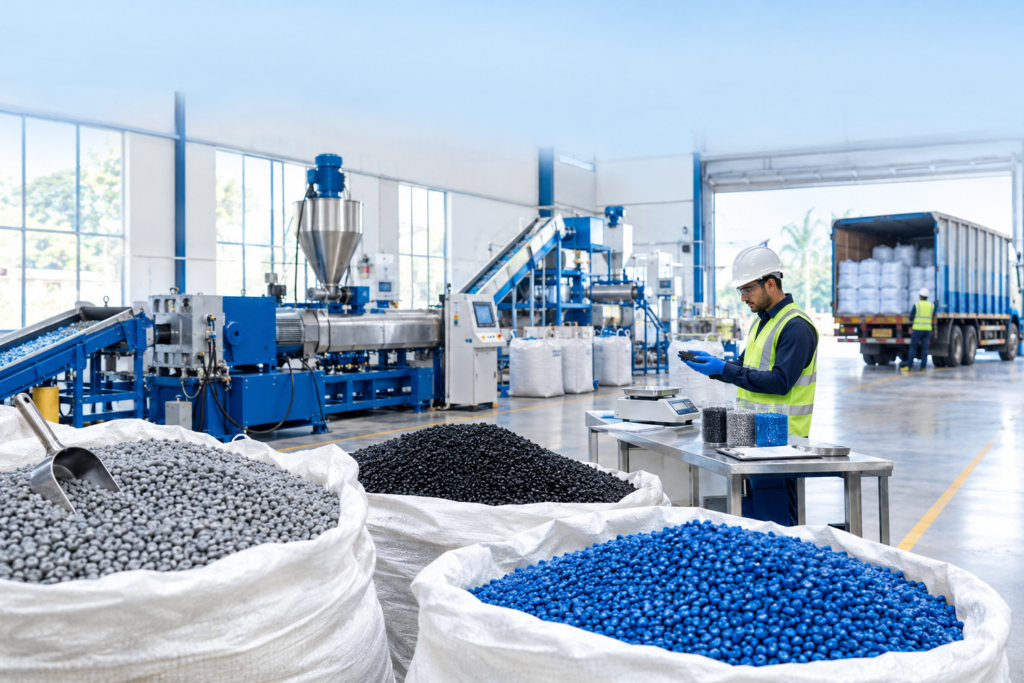
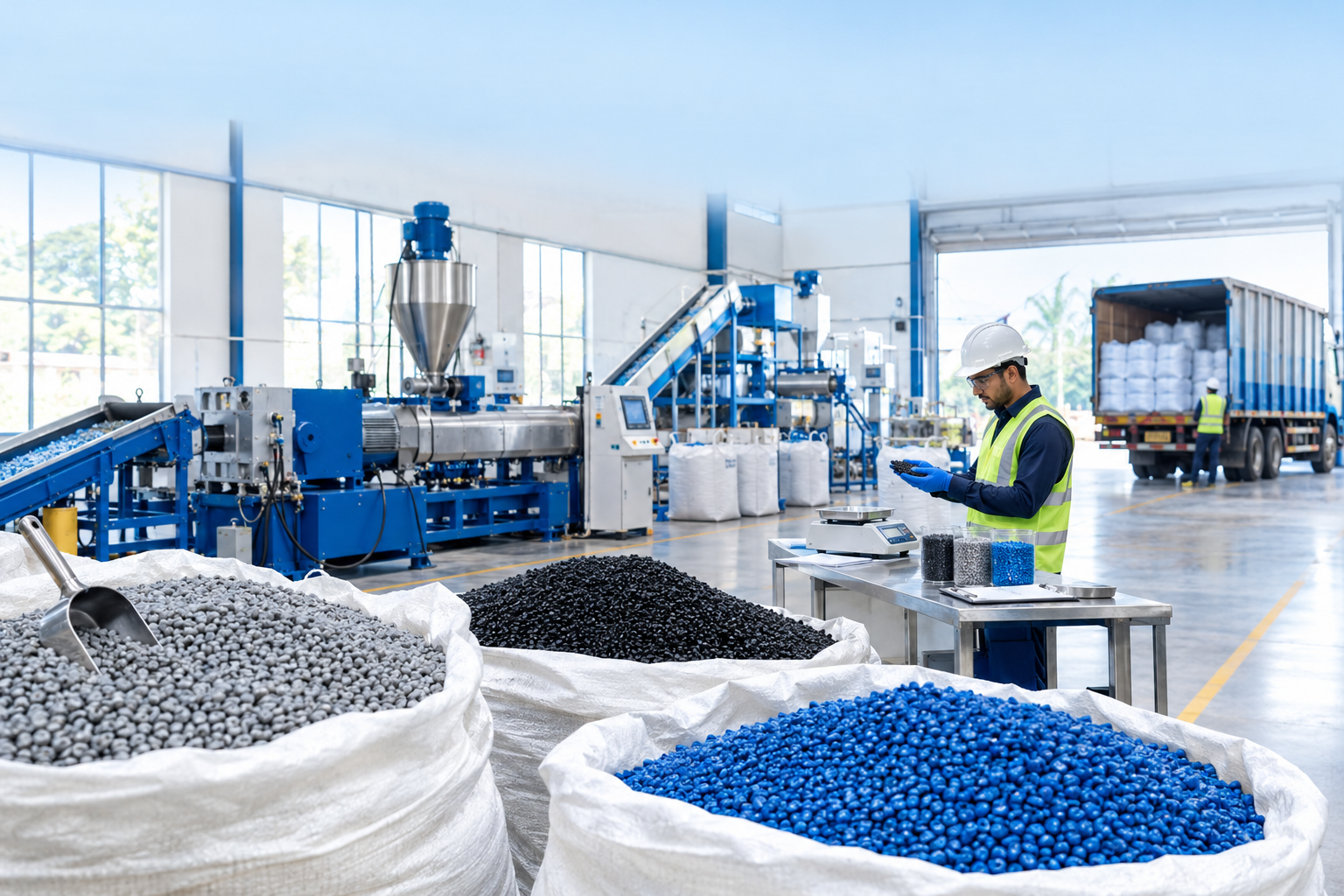
- Reprocessed granules: Material melted, filtered and cut into uniform pellets. They feed consistently and are the most popular form for production.
- Compounded granules: Recycled polymer blended with virgin resin, fillers, colour masterbatch, stabilisers or impact modifiers to meet a defined specification.
- Powder: Finely ground material, mainly for rotational moulding.
Many buyers look for a recycled polymer supplier Gujarat offers specifically for granules or compounds, because consistent quality in those forms is hard to find.
Recycled Polymer vs Virgin Polymer: An Honest Comparison
Recycled polymer is not always a like-for-like replacement for virgin resin, and a trustworthy supplier will say so.
Where recycled performs well:
- Lower and more stable cost
- Good mechanical performance in non-critical products
- Lower carbon footprint
- Helps meet recycled-content expectations from customers and brands
Where it needs care:
- Properties vary more from lot to lot
- Colour is usually limited to grey, black or darker shades
- Repeated heating shortens polymer chains and lowers strength
- Odour or residue may remain in post-consumer material
- Critical, food-contact and medical uses have strict limits
For most manufacturers, the practical answer is blending. Using recycled polymer at a controlled ratio with virgin resin gives savings while keeping quality within specification.
Quality Parameters for Recycled Polymer
Ask your recycled polymer supplier about these points before buying.
Polymer and grade: The exact polymer, and where relevant homopolymer or copolymer, rigid or flexible.
Source: PIR or PCR, and the kind of product it came from.
Melt flow index (MFI): Shows how easily the polymer flows when melted. Match it to your process, because a mismatch causes defects. Ask for the range and the variation between lots.
Density: A quick check for contamination or filler.
Moisture: Wet material causes bubbles and weak products. This matters especially for PET, nylon, ABS and PC.
Ash or filler content: Shows how much mineral filler or inorganic contamination is present.
Contamination: Foreign polymers, metal, paper and dirt. PVC in PET and PP in HDPE are especially damaging. Ask how the melt is filtered and what mesh size is used.
Colour: Natural, grey, black or colour-matched. Ask about colour consistency between lots.
Odour: Post-consumer material can carry smell, which matters for some products.
Mechanical properties: Tensile and impact strength, where your product needs them.
Granule shape and size: Uniform pellets feed smoothly, while fines and tails cause feeding problems.
A reliable recycled polymer supplier Gujarat customers recommend can provide a basic specification for each product and a test report for regular or large orders.
Common Uses of Recycled Polymer in Gujarat
Gujarat’s industries use recycled polymer in many ways:
- Pipes and conduits: Non-pressure drainage, irrigation and electrical conduits using rHDPE, rPVC and rPP. Agriculture-heavy regions such as Saurashtra and North Gujarat use large volumes.
- Crates, buckets and containers: Injection-moulded products using rPP and rHDPE.
- Woven sacks and raffia: Reprocessed PP blended into tape extrusion for cement, fertilizer and grain sacks.
- Film and bags: Recycled LDPE and LLDPE in garbage bags, carry bags and agricultural film.
- Furniture and household goods: Chairs, tables, tubs and hangers.
- Polyester fibre and strapping: rPET flakes and pellets, linked to Surat’s textile industry.
- Automotive and appliance parts: Non-critical components using rPP, rABS and rHIPS.
- Plastic lumber and construction products: Planks, tiles, pavers, fencing and cable trays.
- Rotational moulding: Recycled powder for tanks and bins in non-critical products.
Food-contact, medical and strict-specification products have limits on recycled content, so always check the applicable rules first.
How to Choose a Reliable Recycled Polymer Supplier Gujarat Buyers Can Trust
Many sellers trade in recycled material, but quality and honesty vary. Use this checklist when selecting a recycled polymer supplier Gujarat has available.
1. Confirm the polymer and source
Ask exactly which polymer it is, whether it is PIR or PCR, and what products it came from.
2. Ask for samples
Test a sample in your own process, and compare the first full delivery with it.
3. Ask for specifications and test reports
Request typical values for MFI, density, moisture and ash, and ask how often they are tested.
4. Check consistency
One good lot is not enough. Ask whether the supplier can deliver the same grade every month, and how lots are blended and labelled.
5. Understand the process
Ask about sorting, washing, melt filtration and degassing. A well-run line produces better material.
6. Verify credentials
Look for GST registration, a physical address and clear contact details. Recycling units need pollution control consents and registration under plastic waste rules, so confirm these are in place.
7. Check traceability
Ask whether the supplier can show where the feedstock came from and keep batch records.
8. Compare weighing and packaging
A recycled polymer supplier Gujarat buyers recommend will allow weighbridge verification, pack in clean labelled bags and give proper weighment slips.
9. Look at logistics and payment
Check supply capacity, delivery timelines, GST invoicing and how off-grade lots are handled.
10. Be wary of very low prices
Unusually cheap material is often poorly filtered, wet, mixed or misdescribed.
What Affects Recycled Polymer Price?
Recycled polymer prices move often, so any figure you hear is only temporary. The main factors are:
- Virgin polymer prices: Recycled material usually sells at a discount to virgin, and virgin follows crude oil and global supply.
- Polymer type: Engineering polymers such as ABS, PC and nylon usually sell for more than commodity polymers.
- Source: PIR from known factory sources usually sells for more than mixed PCR.
- Form: Granules cost more than regrind, and compounds cost more than plain granules.
- Colour: Natural and light colours earn a premium, while black and mixed colours sell for less.
- Quality and consistency: Lower MFI variation, lower ash and cleaner melt filtration all raise value.
- Volume and contract length: Larger, regular, long-term orders often get better rates.
- Transport distance: Freight adds to landed cost.
- Season and demand: Agriculture, construction and packaging seasons shift demand.
To compare offers fairly, get quotes for the same polymer, form and colour and look at the total landed cost. A genuine recycled polymer supplier Gujarat businesses trust will be open about how the price is built.
Blending Recycled and Virgin Polymer: Practical Tips
- Start with a small share. Many trials begin at a modest recycled percentage and increase gradually as results prove stable.
- Test each step. Check strength, appearance, dimensions and processing behaviour before increasing the ratio.
- Match MFI. Blending materials with very different flow can cause uneven melt and defects.
- Dry thoroughly. Recycled material, especially PET, must be properly dried.
- Mix well. Use a blender so the ratio stays consistent through the shift.
- Control temperature. Recycled polymer is more heat-sensitive, so avoid overheating.
- Keep records. Note the ratio, supplier lot and test results for each batch.
The right ratio depends on the product and its specification, so run trials before committing.
How Bulk Supply and Dispatch Work
Most suppliers follow a simple process:
- Enquiry: You share the polymer, form, colour, quantity and delivery location.
- Sample and quote: The supplier sends a sample and a price quotation.
- Specification and order confirmation: You agree on specifications, price, payment terms and delivery schedule.
- Packing and weighing: Material is packed in labelled bags or jumbo bags, weighed and recorded, with inspection if you wish.
- Transport: Delivery is by truck, covered to protect from rain.
- Unloading and checking: You check quantity, appearance and moisture on arrival.
- Invoicing and payment: A GST invoice and transport documents accompany the load.
For regular needs, many buyers sign monthly supply agreements with fixed specifications and a price linked to a virgin polymer benchmark. That is a good reason to build a long-term relationship with one dependable recycled polymer supplier Gujarat can provide.
Handling and Storage Tips
- Keep it dry. Store bags under cover on pallets, away from rain and humidity, which matters in Gujarat’s monsoon.
- Keep it clean. Avoid dust, oil and cross-contamination from other polymers.
- Separate by polymer, grade and colour. Label every lot clearly.
- Use first in, first out. Old stock stored in humid conditions may need extra drying.
- Avoid long sun exposure. UV weakens many polymers.
- Mind the fire risk. Plastic is flammable, so keep material away from ignition sources, maintain clear passages and keep fire extinguishers ready.
- Never burn waste. Burning plastic releases harmful fumes, and open burning of plastic waste is prohibited.
Compliance and Environmental Responsibility
Plastic recycling in India falls under the Plastic Waste Management Rules, 2016 (as amended) and pollution control regulations. Enforcement is carried out by the Central Pollution Control Board (CPCB) nationally and the Gujarat Pollution Control Board (GPCB) in the state. In practice:
- Units that wash, process or recycle plastic waste generally need GPCB consent and registration under the relevant rules.
- Open burning is prohibited.
- Wash water must be treated before discharge.
- Records of purchase, processing and sale should be kept.
- Brand owners and producers have Extended Producer Responsibility (EPR) obligations for plastic packaging, which creates demand for verified recycled material and certificates from registered recyclers.
- Rules may set minimum recycled content for certain categories of plastic packaging.
- Food-contact and medical products are subject to separate regulations, and BIS standards may apply to certain products.
Rules change, so confirm current requirements on official notifications or with a compliance professional. A responsible recycled polymer supplier Gujarat customers depend on will be open about its compliance.
Benefits of Buying from a Local Recycled Polymer Supplier
- Lower freight cost: Short distances reduce transport expense.
- Faster delivery: Local suppliers can respond quickly to urgent orders.
- Easy inspection: You can visit the plant, check the process and build trust in person.
- Easy communication: Dealing in Gujarati, Hindi or English makes negotiation simpler.
- Regular feedstock access: Proximity to Gujarat’s industries gives local suppliers steady supply.
- Support for local business: Your purchase supports local jobs and industry.
Questions to Ask Before You Order
- Which polymer and grade is it, and is it PIR or PCR?
- What form and colour is it: regrind, granules or compound?
- What are the MFI, density, moisture and ash values?
- How is the melt filtered, and what is the mesh size?
- Can I get a sample and a test report?
- What quantity is available now and monthly?
- How is the material packed, weighed and loaded?
- What are the payment terms and GST process?
- Can you provide traceability and batch records?
- What happens if a lot is off-grade?
Written answers help avoid disputes later, and any serious recycled polymer supplier Gujarat has should answer these openly.
Common Mistakes Buyers Make
- Buying on price alone. Cheap material with hidden contamination costs more in rejections and downtime.
- Skipping sample trials. Always test before ordering in bulk.
- Ignoring MFI. A mismatch with your process causes defects.
- Using too high a recycled share too early. Increase the ratio step by step.
- Not drying properly. Wet material degrades in processing.
- Depending on a single source. Keep at least two reliable suppliers.
- Poor record keeping. Keep invoices, test reports and batch records for audits.
Explore Our Related Guides
Recycled polymer starts as scrap, so our other guides help you understand each stage. For the input side, read about a plastic scrap dealer Gujarat (link to your plastic scrap dealer post) and a plastic regrind supplier Gujarat (link to your regrind post). For the wider finished-material picture, see our guide to a recycled plastic raw material supplier (link to your recycled raw material post). For specific materials, read our guides to a polypropylene scrap supplier (link to your polypropylene post) and a PET flakes supplier (link to your PET flakes post).
Recycled Polymer Supplier Gujarat: Raghuvir Plastic
At Raghuvir Plastic, we aim to be a dependable recycled polymer supplier Gujarat customers can count on, serving [Rajkot, Ahmedabad, Surat, Vadodara, Morbi and nearby regions] with quality material, honest weighing and on-time delivery. [Edit this section with your real details: the polymers and forms you supply (regrind, granules, compounds), colours, monthly capacity, testing, packaging, delivery areas and traceability.]
Whether you need a trial lot or a regular monthly supply, our team can help you choose the right recycled polymer for your application.
The Future of the Recycled Polymer Market in Gujarat
- Recycled-content targets: Brands and regulators increasingly expect recycled content, so demand for quality material will grow.
- Traceability: Buyers want documented sources, which favours organised suppliers.
- Better sorting and washing technology: Improved lines raise purity and consistency.
- Compounding growth: Specification-driven recycled compounds will take a bigger share of the market.
- Tighter EPR enforcement: Verified recyclers will be in demand.
- Digital trade: Online enquiries and WhatsApp ordering are becoming standard.
Suppliers focused on quality, transparency and compliance will lead the market, and buyers will increasingly turn to a recycled polymer supplier Gujarat has proven over time.
Frequently Asked Questions (FAQs)
Who is the best recycled polymer supplier Gujarat buyers can choose?
The best supplier offers consistent quality, clear specifications, test reports, honest weighing, fair pricing and reliable delivery. Compare several suppliers, test samples and check references.
What is recycled polymer?
It is polymer recovered from plastic waste, cleaned and processed into regrind, flakes, granules or compounds that manufacturers can use in place of, or alongside, virgin resin.
What is the difference between PIR and PCR recycled polymer?
PIR comes from factory scrap with a known polymer and low contamination. PCR comes from used products and needs more sorting and washing, so quality varies more.
Can recycled polymer replace virgin polymer completely?
For some non-critical products yes, but most manufacturers blend recycled and virgin material to keep quality within specification. Test before choosing a ratio.
Which recycled polymers are available in Gujarat?
Common ones are rHDPE, rLDPE and rLLDPE, rPP, rPET and rPVC, along with rABS, rHIPS and smaller volumes of engineering polymers.
Why does melt flow index matter?
MFI shows how easily the polymer flows when melted. If it does not match your process, you can get defects such as short shots, weak spots or uneven surfaces.
How is recycled polymer priced?
Price depends on polymer, source, form, colour, quality, quantity, virgin polymer rates and transport cost. Rates change often, so ask for a current quotation.
Can recycled polymer be used for food packaging?
Food-contact use is strictly regulated and needs approved processing. Check current food safety rules and do not assume that recycled material is suitable.
Can I buy recycled polymer in small quantities?
Many suppliers prefer bulk orders, but some offer trial lots. Ask about the minimum order quantity.
Does a recycled polymer supplier Gujarat wide deliver to all cities?
Many suppliers deliver across Rajkot, Ahmedabad, Surat, Vadodara and Morbi, subject to quantity and freight terms. Confirm delivery options before ordering.
How do I check recycled polymer quality before buying?
Ask for a sample and a test report, and check colour, cleanliness, moisture, MFI and pellet shape. Run a small trial in your own process before placing a bulk order.
Conclusion
Finding the right recycled polymer supplier Gujarat can offer comes down to clarity and trust. Know exactly what you need, which polymer, which form, which MFI range and which colour, and ask suppliers to back it up with samples, specifications, test reports, consistent quality, honest weighing and reliable delivery. Compare total landed cost instead of chasing the lowest rate, blend carefully, keep proper records and stay within environmental and product rules.
Gujarat’s large manufacturing base and strong recycling network make it one of the best places in India to source recycled polymer. With the right recycled polymer supplier Gujarat partner, you can cut raw material costs, keep production steady and support a cleaner, more circular plastic economy.