
Introduction
Choosing the right plastic raw materials for manufacturing isn’t just about picking a resin type — it’s about matching the material form, grade, and specification to your specific production process. A raw material that works perfectly for injection molding may behave completely differently in extrusion or blow molding, and getting this match wrong leads to machine downtime, product defects, and wasted cost.
At Raghuvir Plastic, based in Rajkot, we supply plastic raw materials — both virgin-equivalent recycled flakes and pellets — to manufacturers across Gujarat running injection molding, extrusion, blow molding, and rotational molding operations. In this guide, we break down how to select the right raw material based on your manufacturing process, what specifications matter most for each method, and how to source consistently for your production line.
Why Matching Raw Material to Process Matters
Every plastic raw materials manufacturing process handles differently — different heat profiles, pressure levels, and machine mechanics. A material perfectly suited for one process can cause serious problems in another:
- Injection molding requires raw material with consistent melt flow index (MFI) for even mold filling and dimensional accuracy.
- Extrusion needs material with stable viscosity under continuous, prolonged heat exposure for uniform output like pipes, sheets, or film.
- Blow molding demands raw material with the right parison strength and melt stability to form hollow products like bottles and containers.
- Rotational molding requires fine, uniform particle size and controlled melt behavior for even wall thickness during slow rotation and heating.
Choosing plastic raw materials without considering your specific process is one of the most common — and costly — mistakes manufacturers make, whether sourcing virgin resin or recycled material.
Plastic Raw Materials by Manufacturing Process
Here’s a breakdown of Plastic Raw Materials forms and resin types typically suit each major manufacturing process:
Injection Molding — Preferred Form: Pellets — Common Resins: PP, HDPE, ABS — Key Requirement: Consistent MFI
Extrusion (Pipes, Sheets) — Preferred Form: Pellets — Common Resins: HDPE, PVC, PP — Key Requirement: Stable viscosity under heat
Blow Molding — Preferred Form: Pellets — Common Resins: HDPE, PET — Key Requirement: Parison strength
Rotational Molding — Preferred Form: Fine powder / micro-pellets — Common Resins: PE, PP — Key Requirement: Uniform particle size
Film Manufacturing — Preferred Form: Pellets — Common Resins: LDPE, LLDPE — Key Requirement: Low gel content, consistent melt strength
Raw Materials for Injection Molding
Injection molding units across Rajkot and Gujarat’s manufacturing belt rely heavily on PP and HDPE pellets for producing household goods, industrial components, and automotive parts. Consistent melt flow index across batches is critical here, since inconsistent MFI causes short shots, flash, or warping in molded products. Explore our PP Scrap Supply: https://raghuvirplastic.com/pp-scrap-supply/
Raw Materials for Extrusion
Pipe, sheet, and profile manufacturers need raw material that maintains stable viscosity through continuous, prolonged heating in the extruder barrel. HDPE and PVC pellets are the most common choices for this process. Explore our HDPE Scrap range: https://raghuvirplastic.com/hdpe-scrap/
Raw Materials for Blow Molding
Blow molding, used for bottles, containers, and hollow products, requires material with the right balance of melt strength and parison stability. HDPE and PET are widely used here, with pellets generally preferred over flakes for smoother, more predictable processing.
Virgin vs. Recycled Plastic Raw Materials: What Manufacturers Should Know
One of the most common questions we hear from Gujarat manufacturers is whether recycled raw material can genuinely replace virgin resin in their specific process. The honest answer depends on your application and quality requirements.
Where Recycled Material Works Well
For most standard applications — crates, pipes, woven sacks, industrial containers, and general molded goods — properly processed recycled pellets and flakes perform comparably to virgin resin, at a significantly lower cost.
Where Extra Caution Is Needed
For high-precision applications requiring very tight tolerances, food-contact packaging, or products with strict regulatory certification requirements, manufacturers often use recycled material blended with virgin resin rather than 100% recycled input, to balance cost savings with performance consistency.
The Blending Approach
Many manufacturers in Gujarat successfully use a blend — commonly starting at 20–30% recycled content mixed with virgin resin — and increasing that ratio over time as they build confidence in supplier consistency and process performance.
Key Specifications to Check Before Buying Raw Material for Manufacturing
Regardless of whether you’re sourcing virgin or recycled plastic raw materials, these specifications directly affect your production outcomes:
Melt Flow Index (MFI)
Determines how the plastic raw materials flows under heat and pressure. Mismatched MFI is one of the leading causes of processing defects in injection molding and extrusion.
Moisture Content
Excess moisture causes bubbling, surface defects, and weak spots, particularly in extrusion and blow molding applications.
Particle or Pellet Size Consistency
Uniform size ensures smooth, jam-free feeding through hoppers and screws, especially important for automated, high-speed production lines.
Color and Clarity
For products where appearance matters, consistent color batches reduce the need for excess colorant use and rework.
Contamination Level
Foreign particles or unmelted contaminants can clog nozzles, weaken finished products, and cause visible defects.
At Raghuvir Plastic, we test and grade every batch of plastic raw materials against these parameters before it reaches manufacturers, so your process gets consistent, predictable input every time.
How to Choose the Right Supplier for Manufacturing Raw Materials
Selecting a supplier for your ongoing plastic raw materials needs involves more than comparing prices per kilogram. Consider these factors:
- Process-specific expertise — Does the supplier understand which grade and form suits your specific manufacturing process?
- Consistency across batches — Can they reliably deliver the same MFI, moisture, and quality specifications order after order?
- Sample and trial support — Will they provide sample material so you can test compatibility with your machine before a bulk commitment?
- Local availability — A Gujarat-based supplier reduces delivery time and freight cost compared to sourcing from outside the state.
- Technical support — Can they guide you on blending ratios or troubleshoot processing issues if they arise?
A supplier who understands manufacturing processes, not just raw material trading, becomes a genuine production partner rather than a simple vendor.
How Raghuvir Plastic Supports Gujarat Manufacturers
As a supplier of plastic raw materials for manufacturing, our process is built around understanding what different production lines actually need:
Step 1: Understanding Your Process Requirements
We start by understanding your specific manufacturing process, machine type, and quality requirements before recommending a material grade.
Step 2: Sourcing and Processing
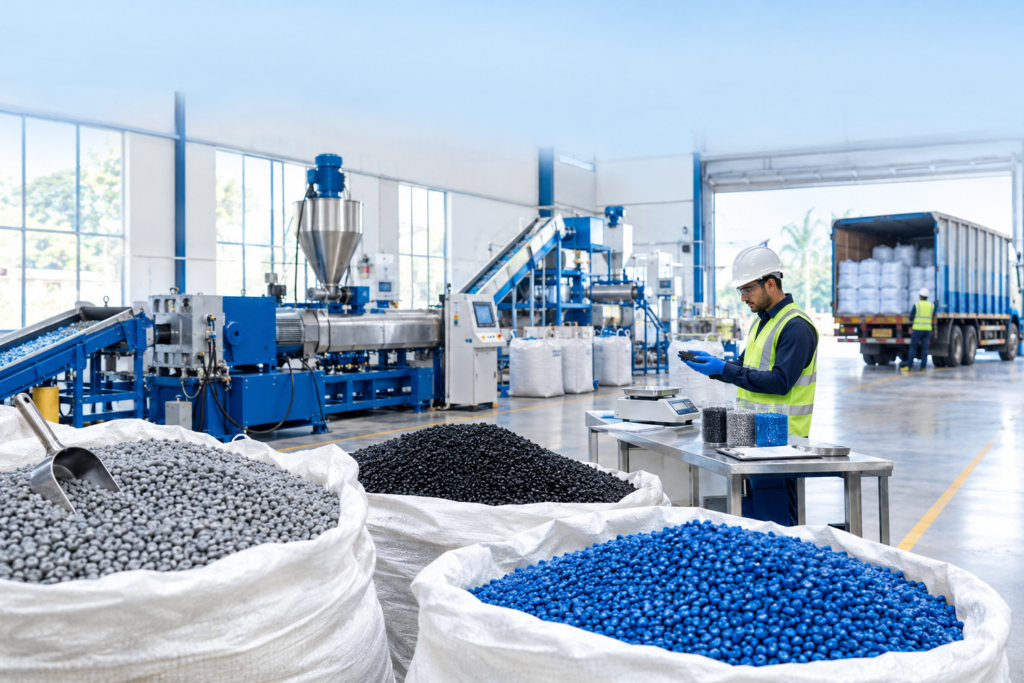
We source and process the appropriate resin type — whether flakes or pellets — through structured sorting, washing, and grading.
Step 3: Quality Testing
Every batch is tested for MFI, moisture, and contamination levels relevant to your specific application before dispatch.
Step 4: Sample-Based Verification
For new manufacturing partners, we provide sample material so you can verify compatibility with your machine before scaling up to bulk orders.
Step 5: Ongoing Bulk Supply
Once verified, we set up consistent, scheduled supply to keep your production line running smoothly without material shortages.
This process-first approach is why manufacturers across Rajkot, Ahmedabad, Surat, and Morbi rely on us for their ongoing raw material needs.
Industries in Gujarat Sourcing Plastic Raw Materials for Manufacturing
A wide range of manufacturing sectors across Gujarat depend on a steady supply of plastic raw materials:
- Injection Molding Units — Household goods, industrial components, and automotive parts manufacturers using PP and HDPE pellets.
- Pipe and Fitting Manufacturers — HDPE and PVC extrusion for construction and agricultural applications.
- Packaging Manufacturers — Containers, crates, and packaging components using HDPE and PP.
- Woven Sack Producers — PP pellets feeding directly into one of Gujarat’s major export industries.
- Film and Sheet Manufacturers — LDPE and LLDPE pellets for packaging film and liners.
- Bottle and Container Makers — HDPE and PET for blow-molded products.
If your business operates in any of these sectors, having a supplier who understands your specific process requirements — not just resin type — makes a meaningful difference in production consistency.
Common Mistakes Manufacturers Make When Sourcing Raw Material
Even experienced production teams sometimes run into avoidable issues when sourcing plastic raw materials:
Choosing Material Based Only on Resin Type
Resin type alone doesn’t guarantee process compatibility. MFI, moisture, and particle consistency matter just as much for your specific machine setup.
Skipping Trial Runs on New Batches
Switching suppliers or grades without a small trial run first can lead to unexpected processing issues discovered only after a large order is already committed.
Ignoring Machine-Specific Requirements
What works well in one machine model may not perform the same way in another, even within the same manufacturing process. Always confirm compatibility with your specific equipment.
Overlooking Supplier Technical Knowledge
A supplier who cannot explain MFI ranges, moisture specifications, or grading criteria may not be equipped to support consistent, process-appropriate supply.
Focusing Only on Per-Kg Price
The cheapest material often comes with inconsistent specifications, leading to production defects that cost more than the initial savings.
Storage and Handling of Plastic Raw Materials Before Production
Sourcing the right plastic raw materials for manufacturing is only half the equation — how you store and handle that material before it reaches your machine also affects final product quality.
Moisture Protection
Pellets and flakes exposed to humid storage conditions can absorb moisture over time, even if they were properly dried at the point of supply. Storing bags in a dry, covered area, and using sealed containers for longer storage periods, helps preserve the material’s processing quality until it’s actually used.
First-In, First-Out (FIFO) Stock Rotation
Using older stock before newer deliveries helps avoid material sitting in storage for extended periods, which can be particularly relevant for color-sensitive or UV-exposed applications.
Avoiding Cross-Contamination in Storage
Storing different resin types and grades separately, clearly labeled, prevents accidental mixing that can compromise batch consistency once material reaches the production line.
Pre-Drying Before Processing
For moisture-sensitive processes like injection molding of certain resins, a short pre-drying cycle before feeding material into the machine can further reduce the risk of surface defects, even when the incoming raw material already meets moisture specifications.
Good storage practices ensure that the quality built into your plastic raw materials for manufacturing by your supplier actually carries through to your finished product, rather than being undermined by handling issues on your own factory floor.
Planning Raw Material Needs Around Production Schedules
Beyond choosing the right grade and form, timing your raw material sourcing around your actual production schedule helps avoid two costly extremes: running out of stock mid-production, or over-ordering and tying up working capital in excess inventory.
Forecasting Based on Order Volume
Manufacturers with predictable order cycles can work with their supplier to plan raw material deliveries a few weeks ahead of anticipated production runs, reducing the risk of last-minute sourcing at less favorable rates.
Building a Small Buffer Stock
Keeping a modest buffer of your most-used raw material grade helps absorb short delays in supply without halting production, particularly useful during monsoon months when logistics across Gujarat can slow down.
Coordinating With Your Supplier on Lead Times
Understanding how far in advance your supplier needs notice for a given order volume helps you plan procurement more accurately, especially for larger batches that may require additional processing time.
Reviewing Usage Patterns Periodically
Tracking how much plastic raw materials your process actually consumes over time — rather than relying on rough estimates — often reveals opportunities to negotiate better bulk pricing or adjust order frequency for cost efficiency.
A well-planned sourcing schedule, built around your actual production rhythm rather than reactive ordering, is often just as important to smooth manufacturing as the raw material quality itself.
How to Start Sourcing Manufacturing Raw Materials from Raghuvir Plastic
Getting started is straightforward:
- Share your process details — Contact us via phone, email, or our Contact Us page (https://raghuvirplastic.com/contact-us/) and tell us your manufacturing process, machine type, and required resin.
- Get a recommendation — We recommend the appropriate raw material grade and form based on your specific requirements.
- Request a sample — We provide sample material so you can test compatibility before committing to bulk quantities.
- Confirm pricing and terms — We share transparent, current pricing and agree on delivery schedule and terms.
- Set up ongoing supply — For regular production needs, we establish a consistent supply schedule tailored to your output requirements.
We currently supply manufacturers not just in Rajkot but across Gujarat, including Ahmedabad, Surat, Vadodara, Morbi, and Jamnagar.
Frequently Asked Questions (FAQs)
Q1. What plastic raw materials does Raghuvir Plastic supply for manufacturing?
We supply PET, HDPE, PP, LDPE/LLDPE, and PVC in both flake and pellet form, suited to different manufacturing processes.
Q2. How do I know which raw material form suits my manufacturing process?
It depends on your specific process — injection molding, extrusion, and blow molding generally require pellets, while some applications can use flakes. Our team can guide you based on your machine type.
Q3. Can recycled raw material fully replace virgin resin in my process?
For most standard applications, yes. For high-precision or regulated applications, a blend of recycled and virgin material is often more practical.
Q4. Can I get a sample before placing a bulk manufacturing order?
Yes, we provide sample material so you can test processing compatibility on your own machine before committing to bulk quantities.
Q5. Do you supply manufacturing raw materials outside Rajkot within Gujarat?
Yes, we supply manufacturers across Gujarat, including Ahmedabad, Surat, Vadodara, Morbi, and Jamnagar.
Q6. What quality specifications do you test before supplying raw material?
We test melt flow index, moisture content, particle consistency, and contamination levels relevant to your specific manufacturing process.
Q7. Why choose Raghuvir Plastic for plastic raw materials for manufacturing?
We combine process-specific expertise, consistent quality testing, sample-based verification, and reliable bulk supply, making us a dependable long-term raw material partner for manufacturers across Gujarat.
Conclusion
Sourcing plastic raw materials for manufacturing isn’t just about finding the cheapest resin — it’s about matching material form, grade, and specification to your specific production process. Whether you run injection molding, extrusion, blow molding, or film manufacturing, the right raw material partner understands these process-specific requirements rather than treating every order the same way.
Raghuvir Plastic has built its reputation in Rajkot on process-first thinking, structured quality testing, and dependable bulk supply of PET, HDPE, PP, and other plastic raw materials for manufacturing. If you’re looking for a supplier who understands your production process, not just your resin type, we’re ready to support your business.
Ready to source the right plastic raw materials for your manufacturing line? Get a Quote: https://raghuvirplastic.com/contact-us/ or call us at +91 93750 99999 / +91 92770 77777 today.
Raghuvir Plastic — Plastic Scrap Trading & Recycling Company, Rajkot, Gujarat. Behind Speedwell Motors Tata Showroom, Navagam, Rajkot – 360003.